
Monrovia People Directory Landscape
Monrovia people directories split into current official lists and historical collections. The City of Monrovia and its school district publish staff contacts. Los Angeles County record systems identify parties to deeds and parcels, while California agencies maintain business and professional lookups. For earlier residents, the Monrovia Public Library, Monrovia Historical Museum, California Revealed, and the Legacy Project preserve sources that ordinary web searches miss.
| Directory | Names Found | Keeper | How to Use It |
|---|---|---|---|
| City staff directory | City staff and officials | City of Monrovia | Free A-Z browse and department filter |
| School staff directory | District and school staff | Monrovia Unified School District | Free online list and search |
| Recorder index | Grantors, grantees, and signators | Los Angeles County RR/CC | Online from 1977; older indexes in person |
| Assessor parcel roll | Parcel and assessment records | Los Angeles County Assessor | Search by address or AIN |
| City and telephone books | Past residents, firms, and addresses | Monrovia Public Library | Library use by appointment |
| Early city database | Residents and businesses | Monrovia Historical Museum | Museum research |
| Professional lookups | Licensed people and businesses | California agencies | Free official searches |
A current public worker belongs in an agency staff directory, not a residential list. An address question may call for the assessor or a reverse city book. Family-history work often needs several Monrovia directory sources because each captures a different year and social setting. The narrow scope of each source is useful: it tells the reader what a match can and cannot prove.
Search Monrovia Staff Directories
The City of Monrovia staff directory is the strongest current municipal directory. It offers an A-Z browse, an All option, and a department filter. Departments visible during research included the City Clerk's Office, City Council, City Manager's Office, Community Development, Fire, Library, Police, Public Works, Recreation, and Administrative Services. Results can be paged and organized through the list columns.
| Search Control | Kind | Required | What It Does |
|---|---|---|---|
| A-Z browse | Letter filter | No | Shows All, #, and surname initials |
| Department | Dropdown | No | Limits the list to one city unit |
| Staff | List column | No | Displays names in last-name-first form |
| Title | List column | No | Identifies the person's city role |
| Phone | List column | No | Shows a public work number |
| Link column | No | Provides an email link when listed |
A typical Monrovia directory result supplies enough detail to distinguish two staff members with similar names. The inspected list showed 79 items, with 20 on its first page.
| Staff | Name shown in last-name-first format |
|---|---|
| Title | Public role, such as supervisor, clerk, or planner |
| Department | City unit tied to that staff entry |
| Phone | Direct public work line in the 626 area code |
| Link labeled Email when available |
If a name is absent, call the relevant department rather than assuming the person has no Monrovia city role. City Hall or the City Clerk can route a question that falls outside the online list.
Note: This Monrovia people directory lists public work contacts and officials; it is not a directory of city residents.
Monrovia School Directory Contacts
The Monrovia Unified School District staff directory supplies the education branch of current local people directories. It presents a searchable staff list, while the California Department of Education district profile is the official fallback for district-level contacts. The district's main office is at 325 East Huntington Drive in Monrovia, with a main phone of (626) 471-2000.
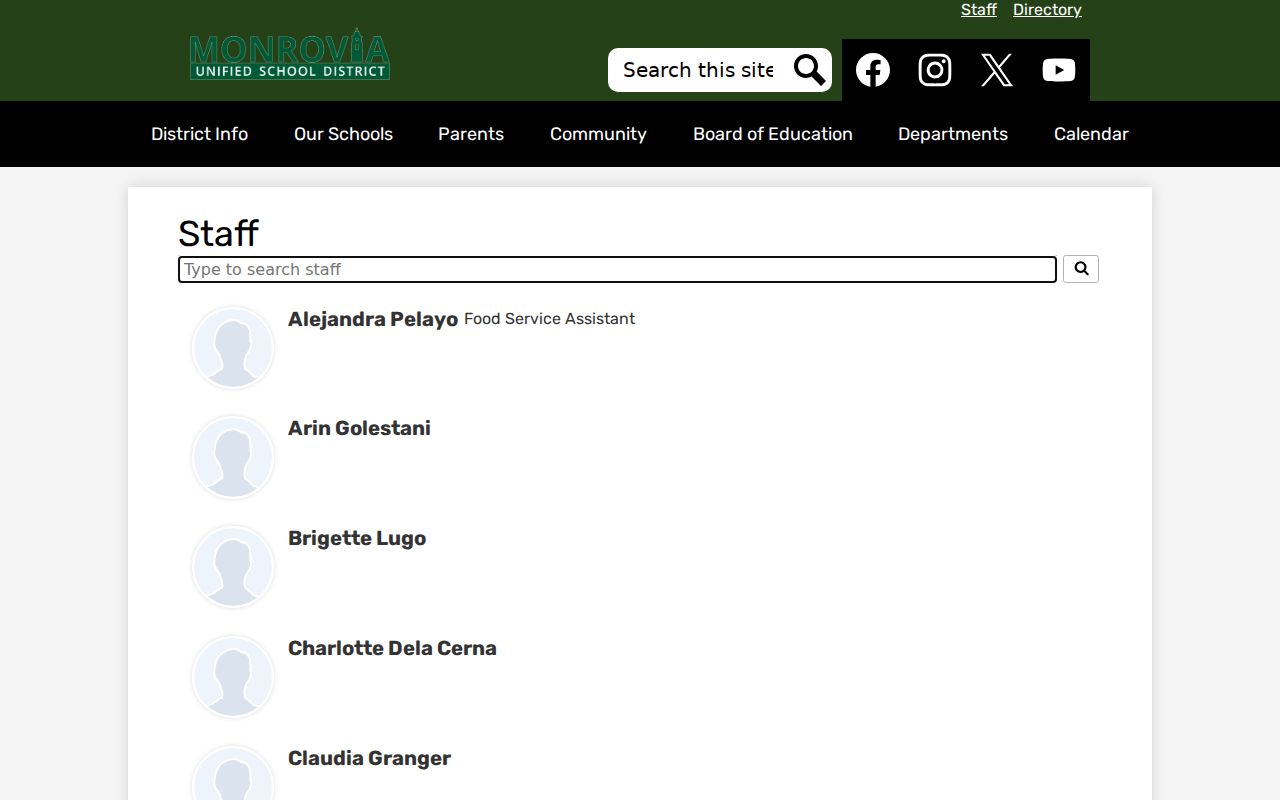
The captured Monrovia Unified directory shows the practical shape of the education list. Use a school or district role to test a name match, then confirm current leadership through the official district or state profile. Historical students and teachers belong in yearbooks instead, since a present staff directory cannot establish earlier attendance.
Monrovia Property Name Directories
County property systems act like directories, but each begins with a different key. The Los Angeles County Assessor Portal accepts an address or Assessor Identification Number, called an AIN. Its parcel detail can show the situs address, which means the physical property location, along with a legal description, land and value fields, bill information, and recording dates. The public portal does not offer a broad owner-name field. Assessor data products may include owner and mailing data.
The Los Angeles County Registrar-Recorder/County Clerk index works in the other direction. It lists grantors, who transfer an interest, grantees, who receive it, and signators. The online Grantor-Grantee directory begins in 1977. Its AIN route applies to documents filed after September 2009. Earlier Monrovia names require the alphabetical name-and-year indexes at the Norwalk office or a historical collection.
Online coverage has limits. Los Angeles County maintains recorded documents from 1851, but the web index does not reach that far back.
The complete access rules, copy routes, and custodian details are covered under Monrovia public records. Here, the key distinction is that the assessor is mainly an address-to-parcel directory, while the recorder is a party-name index for recorded instruments.
Monrovia Professional Directory Searches
Official California directories can test a claimed professional or business connection. The Department of Consumer Affairs License Search uses a board or bureau, license type, license number, and name fields. Its broad coverage includes medical, nursing, pharmacy, accountancy, architecture, barbering and cosmetology, veterinary, funeral and cemetery, security, and many other regulated fields.
The State Bar attorney search accepts an attorney name or bar number and returns status and profile information. Contractor research belongs in the Contractors State License Board lookup, while the Secretary of State business search can expose an entity's status, filings, and names or addresses included in those filings. A business may also appear under a fictitious business name or as an applicant on a Monrovia permit.
Spelling matters. A person, firm, and trade name may differ, so test the official name shown on a license or filing. These directories support verification of a public claim, seller, contractor, or business contact without treating a commercial listing as proof of identity.
Monrovia Library Directory Shelves
The Monrovia Public Library turns an old address or surname into a local directory search. Its city and telephone book run covers 1908 through 1971, though the run is incomplete. The books are for library use with identification, and local-history research is arranged by appointment through reference staff at (626) 256-8274. These volumes may list residents, occupations, firms, and street addresses. Some editions support a reverse route from an address to an occupant.
City and Telephone Books
Coverage: 1908-1971, incomplete
Access: Library use with ID
Best for: Names, addresses, occupations, and firms
Local Newspaper Files
Coverage: 1886-1992, with gaps
Access: Microfilm and some digitized papers
Best for: Obituaries, clubs, notices, and school news
Historical Permits
Format: Microfiche
Access: Appointment and scanner support
Best for: Owners, applicants, contractors, and addresses
Newspaper microfilm starts with the Monrovia Planet in December 1886 and continues through several local titles to the Monrovia News Post in July 1992, with missing dates. Digitized newspapers cover 1886 to 1923. When a directory gives only a name and address, nearby newspaper years can add an obituary, business notice, school item, or civic role.
Note: Library directory and microfilm work is appointment-based, so confirm access with reference staff before planning a research visit.
Museum's Early Monrovia Directory
The Monrovia Historical Museum research collection reaches into the city's first years. Its searchable city-directory database holds more than 9,000 entries from 1888 through 1917, with certain streets represented in other years. The museum also has more than 11,000 artifact and document records dating from 1888, Monrovia High School and Clifton Middle School yearbooks, tract maps, and material on churches, civic groups, and city government.
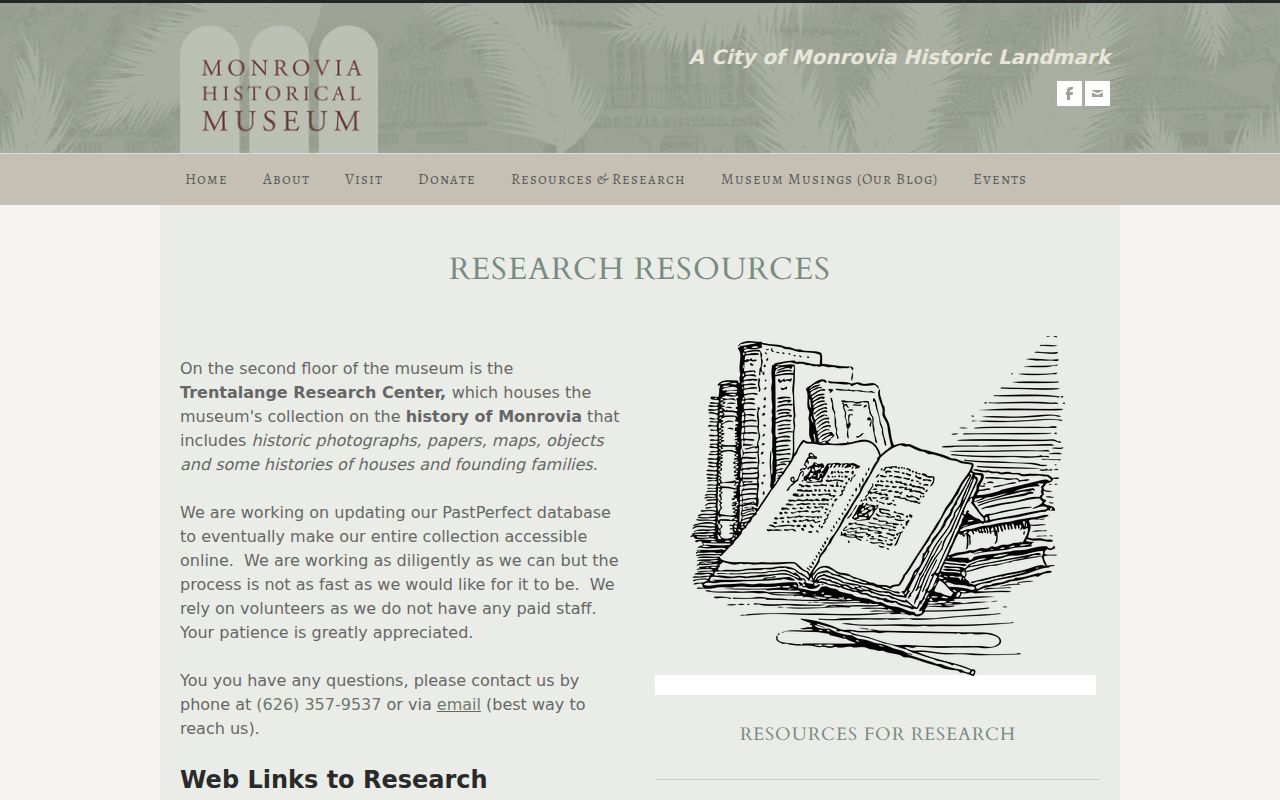
The museum capture points to several directory types under one roof. A surname can move from an early city entry to a yearbook, church file, civic organization, or subdivision map. That cross-check is valuable because an old city directory may abbreviate a first name, list a woman under a spouse's initials, or cover only selected streets.
Monrovia Legacy Project Directory
The Monrovia Legacy Project is a community-memory database rather than a formal resident directory. Its historic photographs and papers attach names to early businesses, clubs, schools, farms, railroads, groups, and neighborhoods. A direct match may be a person named in an item record. An indirect one may be a class, organization, shop, or street connected to that person.
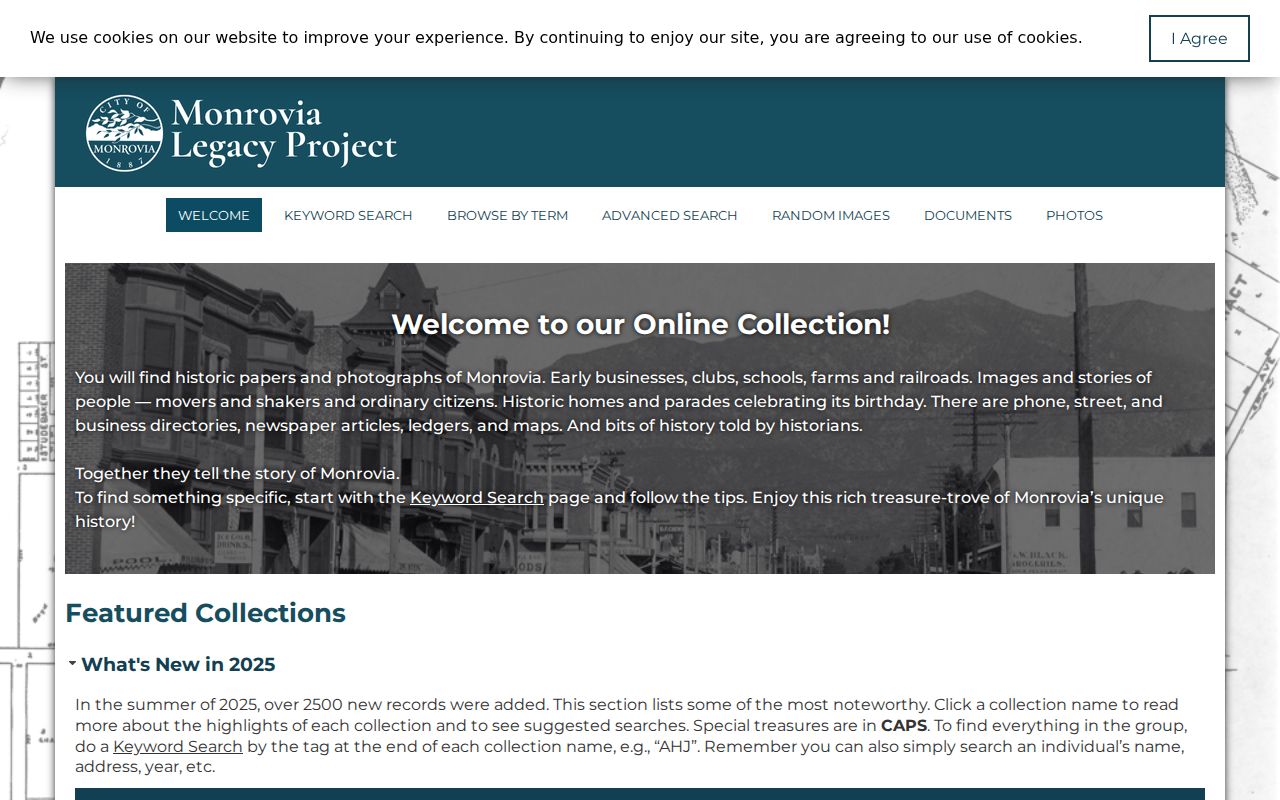
The online collection makes local context searchable from home. Record the title, date, people named, organization, and object identifier for each useful item. Then compare those details with the museum database, a city book, a yearbook, or newspaper coverage. Images can identify a social link that a county deed never records.
Monrovia's Tri-City Directory Quirk
A single mid-century volume expands Monrovia directory research beyond the city line. The 1950 Monrovia, Arcadia and Duarte City Directory at California Revealed combines an alphabetical list of private citizens and businesses with a street and avenue guide of householders. It therefore works both name-to-address and address-to-occupant.
The digitized record also explains a local geography trap. A Monrovia-area person may appear under Arcadia or Duarte in this shared directory, so a city-only query can miss a useful entry. Search the surname and street in the whole volume, then note which city heading or householders section supplies the match.
Directory reading tip. Owners and occupants are not always the same person. Compare a householder entry with parcel and deed evidence before drawing a conclusion.
Historical Monrovia People Directories
Monrovia's directory era overlaps in useful layers. The city incorporated in 1887. The museum database begins the next year, the library books start in 1908, the digitized tri-city volume fixes a clear point in 1950, and the library run reaches 1971. Together these holdings provide more than 80 years of local name-and-address evidence outside modern portals.
- Alphabetical directory
- A surname-first list that may pair a resident or business with an address and occupation.
- Reverse directory
- A street-first list used to identify the household or firm at a known address.
- Yearbook
- A school volume that may identify students, faculty, teams, clubs, and class years.
- AIN
- The Los Angeles County Assessor Identification Number assigned to a parcel.
Begin with the year nearest the event being researched. Save the exact spelling and street form used in that source. Then check nearby years for moves, name changes, household shifts, or a business succession. Older directories may use initials and spelling variants, while newspapers and yearbooks may supply the full name.
For lawful family history, former-classmate research, estate questions, or local civic study, these Monrovia people directories are strongest when treated as linked snapshots. No one entry proves that two people are the same. Agreement across a directory, newspaper, yearbook, permit, or county record makes the identification far more sound.