
Use Monrovia Voter Status Tools
The Los Angeles County Voter Registration Verification tool is meant to determine the user's own registration status. Its form is dynamic, and the exact identifying labels were not exposed in static source. Enter the voter information the live form requests and submit it to confirm status. Do not treat it as a browse-by-name index of everyone registered in Monrovia.
| Lookup control | Input kind | Needed? | Verified use |
|---|---|---|---|
| Voter identifying information | Text and date fields | Yes | Dynamic form uses identifying data for self-verification |
| Submit or Search | Button | Yes | Determines registration status |
| Language and site search | Header controls | No | Changes site access, not the voter record |
If the tool cannot confirm a status, contact the county elections office. A failed match does not prove that a person never registered, moved, or has a protected record. The public cannot turn this self-check into an unrestricted voter-roll search.
County staff can also clarify whether the problem concerns a pending update, the identifying information entered, or a registration issue that needs action by the voter. Keep the confirmation screen for personal election planning, but rely on the elections office when the displayed status conflicts with a recent registration transaction.
Note: Enter only information requested by the official form, and use the elections office when identity details or record status need correction.
Compare Monrovia Voter Lookup Tools
California offers a second self-service route through My Voter Status. It can report registration status, political party preference, language preference, polling or vote-center information, and vote-by-mail or provisional-ballot status. Los Angeles County's tool is the direct local route, while the Secretary of State tool provides the statewide path. Both are designed for voter self-service, not general public research.
The California My Voter Status portal displays the official state lookup.
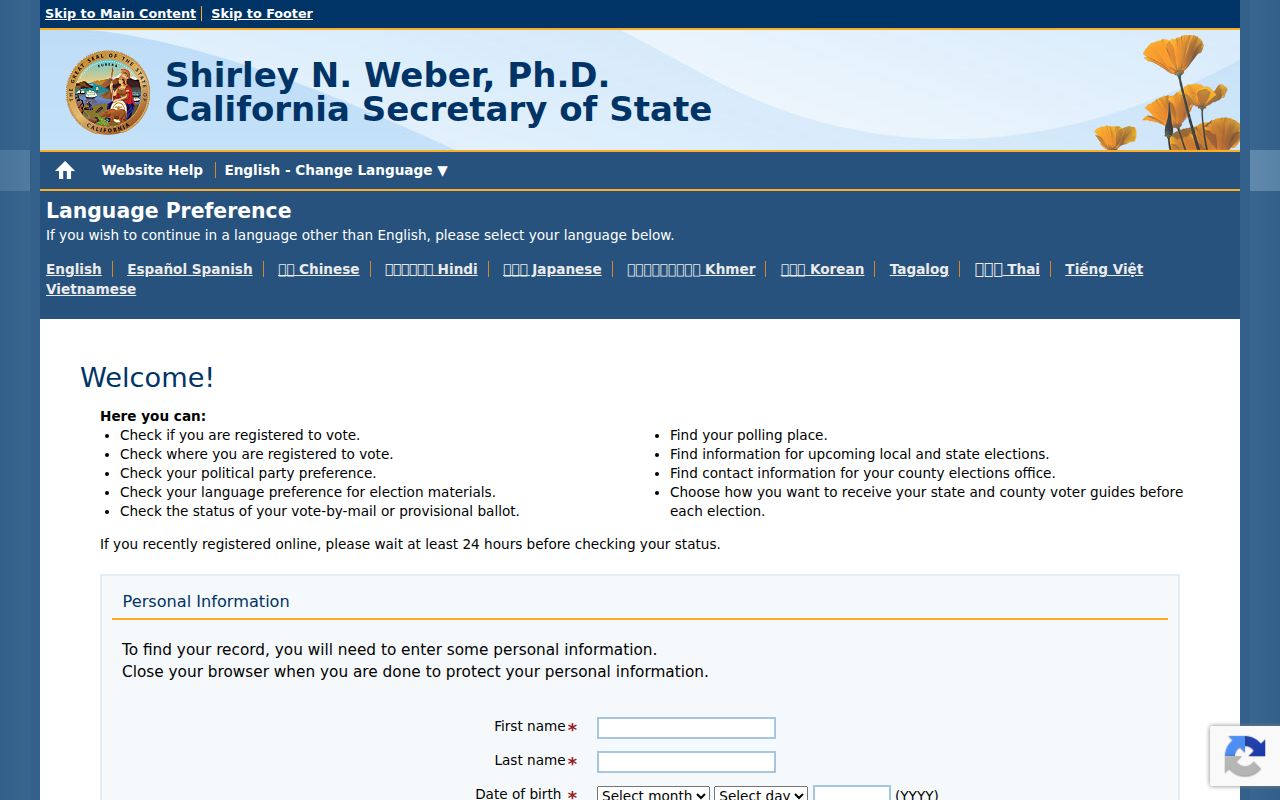
The form's identity checks support personal access and help keep the voter roll from becoming a public directory.
A status tool and a voter file serve different needs. The first helps one voter check registration and election details. The second is a regulated data release for a documented purpose. That comparison is central to understanding Monrovia voter access.
Fields in Monrovia Voter Records
A California voter file may contain several groups of fields, to the extent each item exists in an individual record. Registration data identifies the voter and registration county. Status and history fields describe the record over time. A voting-history file records participation, never the choices marked on a ballot. District data connects the voter to election districts.
| Identity | Name and unique registration identification number |
|---|---|
| Contact | Residential and mailing address, phone, and email when present and releasable |
| Preferences | Language and party or political preference where applicable |
| Registration | County, status, and registration history fields |
| Participation | Voting history showing participation, not ballot selections |
| Geography | District file used for election administration |
Release is not automatic merely because a field exists. The approved purpose, applicant, confidentiality law, and protected-voter status govern what can be supplied. A personal status screen also does not necessarily display every field found in a permitted file export.
Confidential Monrovia Voter Information
California Elections Code § 2194 and Government Code § 7924.000 make the core voter-registration affidavit information confidential from routine public access. It cannot appear on public terminals, lists, affidavits, or other media routinely available at the county elections office. The 2026 statutory text continues the approved-purpose framework and expressly protects sensitive identifiers.
Confidential by law. Driver license and state ID numbers, Social Security numbers, HAVA voter identifiers, voter signatures, and protected-voter records are not disclosed through routine voter access.
A signature may be viewed or compared only in limited circumstances set by law. Protected records under Elections Code §§ 2166 through 2166.9 remain shielded. These limits apply even when another voter field could be released to a qualified applicant. California voter-roll data is therefore not public open data, despite the existence of regulated request channels.
Request Monrovia Voter File Data
The Secretary of State accepts applications for election, scholarly, journalistic, political, or government use. The applicant must document the proposed purpose, supply a clear copy of a current driver license or state ID, sign the agreement with an original signature, and pay the proper fee. Applications go by mail or hand delivery to the Elections Division in Sacramento. Email and fax are not accepted.
- Choose statewide, county, district, or specific-voter data. A specific-voter application may name up to 10 records.
- Complete applicant contact fields, explain the approved use, attach the required documentation and ID copy, then sign the certification.
- Mail or hand-deliver the original application and fee. The Secretary of State reviews completeness and whether state law allows the stated use.
- Protect the released data, restrict access to the approved work, and do not transfer it to an unauthorized recipient.
State registration data costs $15 per thousand records, capped at $100. A specific voter record costs $30, with the application capped at $100. Review and processing can take 7 to 14 business days after receipt. County, statewide, or district requests are distributed in encrypted form as plain-text, tab-delimited voter, voting-history, and district files. Specific records arrive as an encrypted email attachment.
The three-file structure matters when reading Monrovia voter data. The voter file holds registration fields, the history file tracks whether elections were participated in, and the district file supplies election geography. None of them reveals how a ballot was marked. Applicants should request only the scope needed for the approved work and keep each file encrypted during use.
Monrovia Voter Name Search Requests
Los Angeles County offers a distinct voter-information request at $5 for each name searched. It is not the self-check screen and not an open online list. A requester may visit the Election Information Section at RR/CC and complete a form, or submit a written request by mail.
The mail request must include the requester's name, address, birth date, signature, and telephone number, plus a self-addressed stamped envelope. It goes to Registrar-Recorder/County Clerk, Election Information Section, 12400 Imperial Highway, Room 2013, Norwalk, CA 90650. The required requester details reinforce that this is a controlled office process.
The LA County voter information request page lays out both channels.
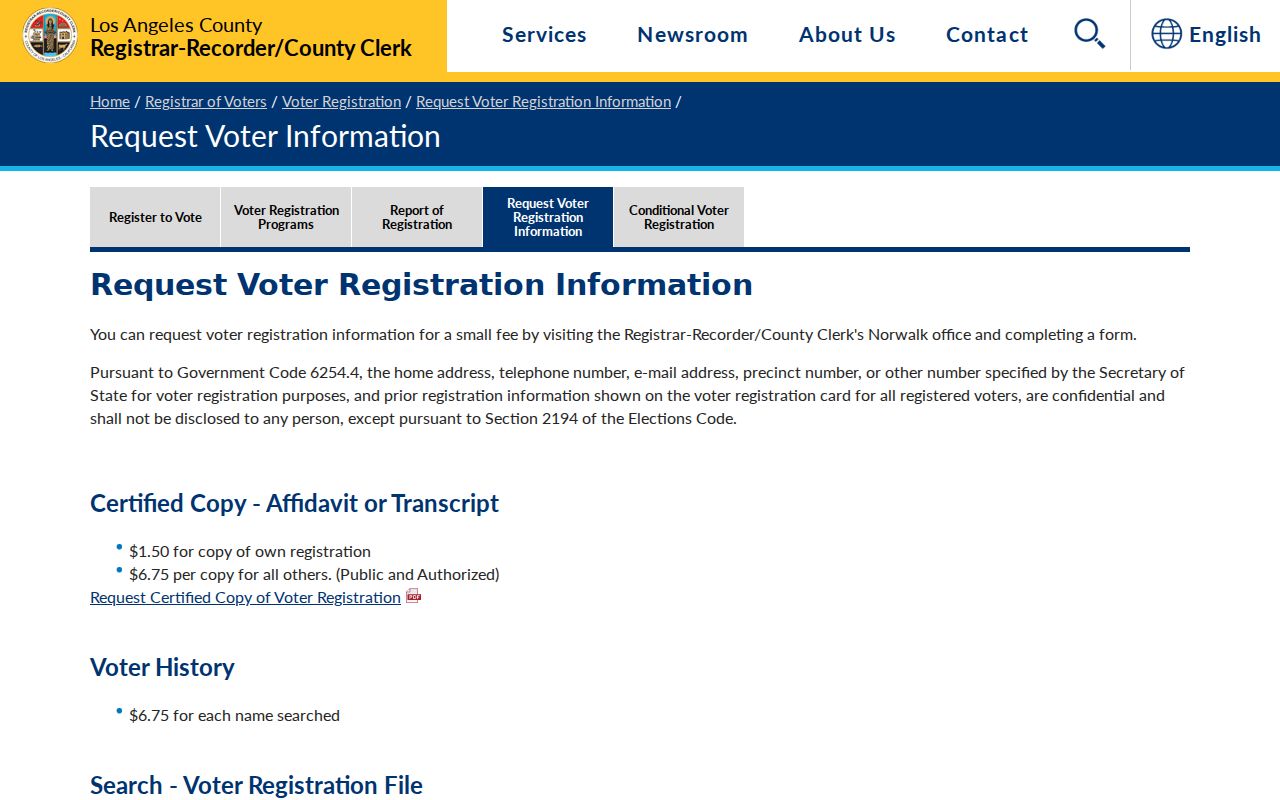
The instructions distinguish a paid office name search from the free status check used by an individual voter.
Monrovia Voter Records Use Limits
Approval attaches to a specific use. Elections Code § 2194 bars personal, private, commercial, advertising, and marketing use. The state application also prohibits unauthorized sharing, leaving the data unsecured online or offline, and harassment of a voter or household. It addresses certain advertising text messages and requires compliance with the approved purpose.
Elections Code § 18109 makes unlawful voter-information use a misdemeanor and can bring significant fines. A qualified recipient cannot provide the file to a person who did not receive approval. Access control, secure storage, and deletion after the work is complete are practical parts of compliance.
Use restriction. Never use Monrovia voter records to harass a voter or household, advertise, market, or pursue any purpose outside the approved application.
Protected Monrovia Voter Addresses
California Safe at Home gives qualifying participants a substitute mailing address that state, county, and city agencies accept in place of a residence or mailing address. The program helps keep the actual residence confidential. It explains why a lawful search may show a substitute address or no ordinary address trail.
Protected voter records are withheld under the election statutes cited in the state guidelines. A data recipient should not attempt to infer or uncover a protected home address from other voter fields. The confidentiality rule is an intended safety control, not an error to work around.
The Secretary of State Safe at Home page explains the program and current qualifying categories.
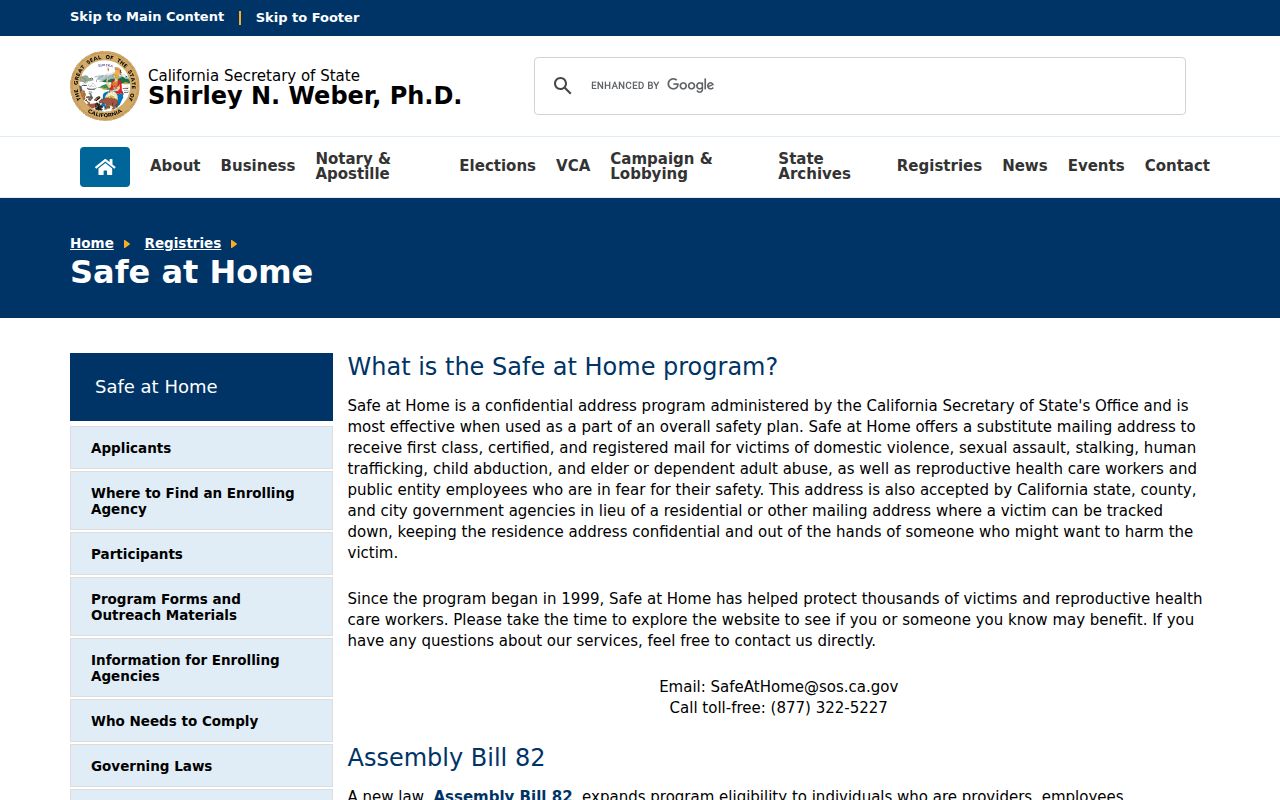
The official page is the right source for eligibility and program contact details; voter tools should never be used to defeat those protections.
Historical Monrovia Voter Research
The research did not locate a confirmed official online run of Monrovia poll books or historical registration registers. Do not claim specific years without a catalog record. The sound fallback is to ask the California State Archives and Los Angeles County election-record custodians about surviving registers, then check Monrovia library newspapers for election notices and local political coverage.
Historical voter work differs from a current voter-file request. Newspapers may document candidacy, precinct activity, civic groups, and election disputes without exposing protected modern registration data. County archives may have administrative election material even when an individual register is unavailable. Exact collection titles, access rules, and dates should be confirmed before a visit.
Monrovia newspapers on library microfilm begin in the late 1880s and continue through several titles into 1992, with gaps. Those runs can supply election notices, candidate names, precinct stories, and civic context. They are not substitutes for official voter records, yet they may answer a historical question when no surviving register has been verified.
General access law does not convert the current voter roll into public data. For a broader explanation of agency requests, use the natural Monrovia public records process; voter files remain governed by election-specific statutes.